

 English
Alloy Steel Chain Slings: 80 and 100 Grade Guide
Content
- 1 What are alloy steel chain slings?
- 2 80th grade vs. 100th Grade: Understanding the Fundamental Difference
- 3 High Temperature Lifting: Why Chain Slings Are Great
- 4 Final accessories and configuration options
- 5 Certification standards: EN 818-4, ASME B30.9 and GB/T 10051
- 6 Inspection, maintenance and retirement criteria
- 7 Choosing the Right Chain Sling for Your Application
What are alloy steel chain slings?
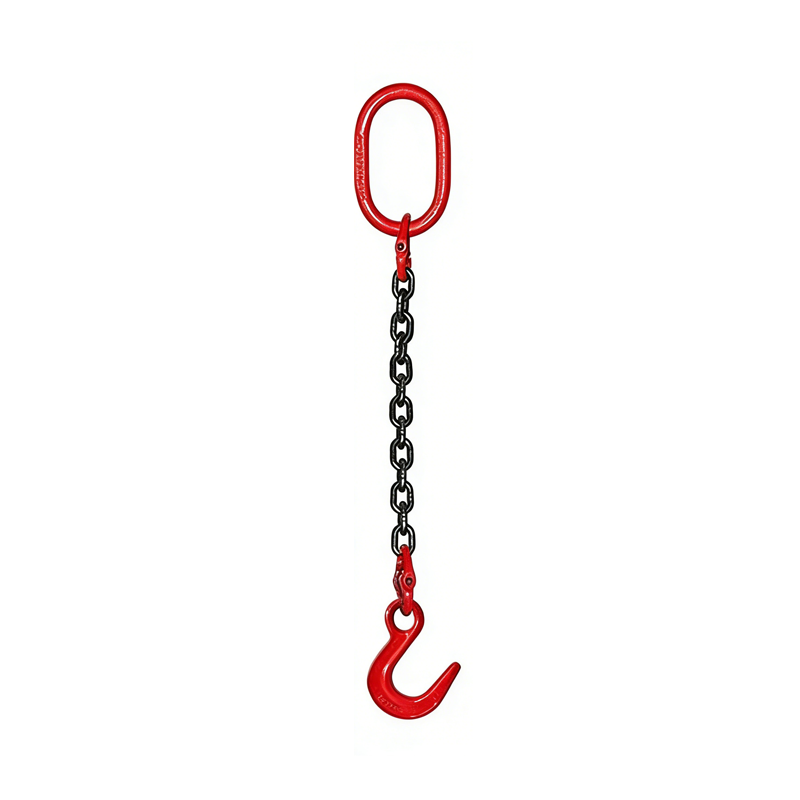
alloy steel chain slings are heavy-duty lifting assemblies designed for industrial applications that require strength, durability and reliability under extreme conditions. Each sling is constructed from interconnected high-strength alloy steel chain links with a master link at the top and end fittings - such as hooks, rings or hooks - at the working ends. Unlike synthetic alternatives, alloy steel chain slings do not stretch, fray or degrade when exposed to sharp edges, abrasive surfaces or elevated temperatures, making them the standard choice for foundries, steel mills, construction sites and heavy manufacturing environments.
Chain slings are available in four main leg configurations: single leg, double leg, triple leg and four paws . Each configuration distributes the load differently and is selected based on the shape, weight, and balance requirements of the object being lifted. One single leg sling is ideal for simple vertical lifts, while multi-leg slings provide superior load control for asymmetrical or oversized loads.
80th grade vs. 100th Grade: Understanding the Fundamental Difference
The grade of a chain sling refers to the minimum breaking strength in relation to the cross-sectional area of the chain – a higher grade means greater strength in the same diameter. When selecting alloy steel chain slings, the choice between grade 80 and grade 100 is one of the most critical decisions, directly affecting working load limits, sling weight and cost efficiency.
| Feature | 80th series | Note 100 |
| Minimum breaking strength | 800 N/mm² | 1000 N/mm² |
| Relative Strength | Industry baseline | ~25% stronger |
| Sling weight (same WLL) | Heavier | Lighter |
| Color code (common) | Yellow/Orange | Purple / Violet |
| Typical Application | General industrial lifting | High-strength, weight-sensitive elevators |
| Standards | EN 818-4, ASME B30.9, GB/T 10051 | EN 818-4, ASME B30.9, GB/T 10051 |
Grade 80 chain slings have long been the industry standard and continue to be widely used for general purpose heavy lifting. They offer excellent strength, a proven track record, and broad compatibility with most rigging hardware. However, grade 100 chain slings offer approximately 25% higher working load limits on the same chain diameter – meaning you can lift heavier loads with a lighter, more manageable sling assembly. This is particularly valuable in operations where erector fatigue, setup speed and crane capacity are key factors. Both classes meet EN 818-4, ASME B30.9 and GB/T 10051 standards, ensuring full traceability and cargo certification.
High Temperature Lifting: Why Chain Slings Are Great
One of the most distinctive advantages of alloy steel chain slings over synthetic or steel rope alternatives is their exceptional performance as high-temperature lifting slings. Nylon and polyester slings can begin to lose structural integrity at temperatures as low as 80°C, while wire rope slings are susceptible to heat-induced fatigue and core degradation. Alloy steel chain slings, on the other hand, are rated for continuous use at temperatures up to 400°C with appropriate reduction in working load limit.
According to ASME B30.9 guidelines, the working load limit of a chain sling should be reduced when used in high temperature environments. The following reductions apply as general industry guidance:
- Up to 200°C: No reduction in WLL required
- 200°C to 300°C: Reduce WLL by 10%
- 300°C to 400°C: Reduce WLL by 25%
- Above 400°C: The sling must be removed from service and recertified before further use
This makes alloy steel chain slings the only practical option for handling hot billets in steel mills, molten mold transfers in foundries, and furnace-related lifting in ceramic or glass manufacturing. It is critical to allow slings to cool before inspecting them after use, as heat exposure is cumulative – each high-temperature cycle gradually affects long-term workload capacity.
Final accessories and configuration options
The versatility of alloy steel chain slings is further expanded by the variety of accessories available. Selecting the correct attachment is as important as choosing the correct grade and number of legs, as inappropriate attachments can compromise safety and control of the load.
Common Types of End Fittings
- Sling Hook (Sliding Hook): Large throat hooks, typically self-locking, used for general overhead lifting. Suitable for most standard applications.
- Self-Locking Hook: Rotates in the center and automatically locks under load pressure, preventing accidental release during lifting. Essential for dynamic or high vibration environments.
- Casting Hook: Features an extra-large throat opening designed to accommodate bulky load attachment points commonly used in foundry and molten metal handling.
- Grab Hook: It has a narrow throat that clamps directly between the chain links, allowing the sling's working length to be shortened without reducing the rated capacity.
- Oblong master link: The top ring that connects all the legs to the crane hook or hoist. Must match the correct load rating for the complete assembly.
For multi-legged slings, the angle of the legs significantly impacts the effective working load limit. As the angle between the legs increases beyond 60°, the tension in each leg increases markedly. Always refer to the load angle factor chart provided with Grade 80 or Grade 100 certified chain slings to confirm the correct WLL for your lifting geometry.
Certification standards: EN 818-4, ASME B30.9 and GB/T 10051
Certified alloy steel chain slings are manufactured and tested in accordance with internationally recognized standards governing material properties, proof load testing, marking and traceability. Understanding which standard applies to your region or export market is essential for compliance and insurance purposes.
- EN 818-4: The European standard for short link chain slings for general lifting purposes. Covers current classes, assembly tests, marking requirements and safety factors. Mandatory for CE marked slings sold in EU markets.
- ASME B30.9: The American standard governing the construction, attachment, use, inspection, and maintenance of slings—including alloy steel chain slings. Widely referenced in North American industrial operations.
- GB/T 10051: China's national standard for lifting chain slings, covering round-link and short-link chains. Mandatory for slings used in lifting operations certified under Chinese regulatory frameworks.
Each compatible sling is labeled with a durable nameplate or label listing the sling style, serial number, chain size, class, working load limit and manufacturer details. This complete traceability allows operators and safety managers to maintain accurate inspection records and pull records for each individual sling in their inventory — a requirement of OSHA regulations and equivalent international workplace safety codes.
Inspection, maintenance and retirement criteria
Regular inspection is non-negotiable for any lifting operation. Alloy steel chain slings must be inspected before each use and subjected to a thorough periodic inspection at intervals determined by frequency of use, severity of application and applicable regulations. Key indicators that a sling should be removed from service include:
- Chain link wear exceeding the minimum allowable thickness specified by the manufacturer
- Cracks, grooves or deformations in any link, master link or end fitting
- Stretching individual links beyond 3% of original length
- Damaged, illegible or missing identification labels
- Thermal discoloration indicating exposure above 400°C without subsequent recertification
- Chemical corrosion, corrosion or any surface damage that compromises the integrity of the link
Proper storage also extends the life of the sling. Store alloy steel chain slings on designated hooks or racks – never on the floor where they will be exposed to moisture, chemicals or vehicle traffic. After use in high temperature environments, allow slings to cool completely before coiling and storing. Lubricate chain links periodically with a light machine oil to prevent surface corrosion, especially in outdoor or high humidity applications.
Choosing the Right Chain Sling for Your Application
Selecting the correct alloy steel chain sling requires evaluating several interdependent factors. Use the following checklist as a practical starting point before placing any order or initiating a withdrawal:
- Load weight and center of gravity: Determine the maximum load and ensure that the WLL of the sling – taking into account the leg angle – exceeds it with an appropriate safety margin.
- Operating Temperature: If the application involves hot materials or environments above 200°C, a high temperature lifting sling configuration with grade 80 or grade 100 alloy chain will be required. Apply the correct WLL reduction.
- Leg configuration: Single leg for balanced vertical lifts; two-, three- or four-legged slings for wide, irregular loads or loads with multiple accessories.
- End fitting type: Match the type of hook or ring to the geometry of the load securing point and the level of risk of accidental disengagement.
- Compliance Standard: Confirm which standard — EN 818-4, ASME B30.9, or GB/T 10051 — is required for your market or regulatory environment.
- Chain diameter and length: Make sure the sling dimensions accommodate the geometry of your rigging without excessive play or excessive tension on any leg.
If in doubt, consult a certified rigging engineer or the sling manufacturer's technical team. The consequences of an undersized or incorrectly specified chain sling are serious – proper selection is as important as proper use. Grade 80 and Grade 100 alloy steel chain slings represent the industry's most reliable tools for demanding lifts and, with the correct specifications, inspection discipline and operational practice, deliver safe, repeatable performance over thousands of lifting cycles.
Contact Us
-

-
 +86-13395162883 / +86-0510-86361180
 -
 No. 25 Xizhang Road, Changshou Village, Zhouzhuang Town, Jiangyin City, Wuxi City, Jiangsu Province, China


- Quick Links
- Product Categories
- Wire Rope
- Wire Rope Fittings
- Chain
- Wire Rope Accessories
- Packaging Types

Message Us Now !
