


 English
Grade 100 Alloy Steel Chain: Strength, Specs & Safety
Content
- 1 Metallurgical foundation and heat treatment
- 2 Working load limits and design factor requirements
- 3 Distinguishing Grade 100 from lower grades
- 4 Sling assembly and component compatibility
- 5 Fatigue behavior and service life considerations
- 6 Periodic inspection protocols and rejection criteria
- 7 Storage, handling, and environmental protection
Grade 100 alloy steel chain delivers the highest strength-to-weight ratio among all standardized overhead lifting chains, with a working load limit approximately 25% higher than Grade 80 chain of the same diameter. This performance stems from a precisely controlled quench-and-temper heat treatment that produces a fine-grained martensitic microstructure with a minimum ultimate tensile strength of 1,000 MPa (145,000 psi). For lifting engineers and rigging supervisors, the practical consequence is straightforward: a 13 mm Grade 100 chain legally replaces a 16 mm Grade 80 chain in a sling assembly, reducing sling weight by roughly 35% while maintaining identical capacity.
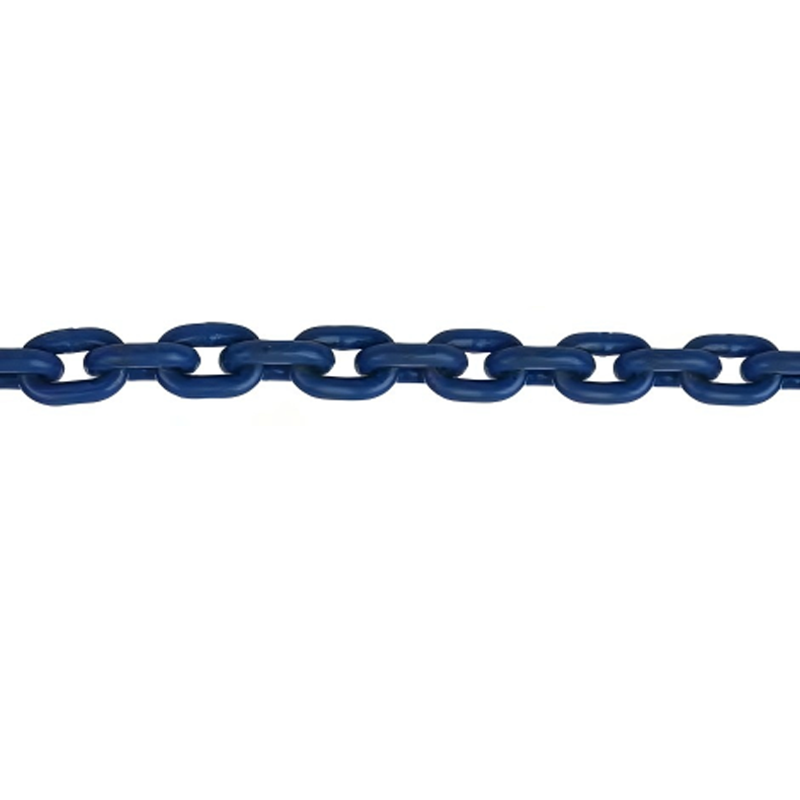
Metallurgical foundation and heat treatment
The "Grade 100" designation refers to the chain's minimum ultimate tensile strength of 1,000 N/mm² (100 kg/mm², hence the Grade 100 nomenclature). The base material is a boron-treated medium-carbon alloy steel, typically a modified 23MnNiMoCr54 or equivalent DIN 17115-compliant grade. Boron at concentrations of 0.0008% to 0.003% dramatically increases hardenability without the cost penalty of high nickel or molybdenum content, allowing the chain to achieve full through-hardening in diameters up to 45 mm.
The critical manufacturing sequence begins with electric-resistance butt welding of the link after forming. The weld flash is trimmed hot, and the entire chain length enters a continuous austenitizing furnace held at 880°C to 920°C (1616°F to 1688°F). Quenching follows immediately in a water-polymer solution that cools the chain rapidly enough to avoid the ferrite-pearlite nose on the continuous cooling transformation diagram. Tempering at 400°C to 500°C (752°F to 932°F) relieves residual stresses and trades a small fraction of ultimate tensile strength for impact toughness, yielding a final hardness range of 30 to 38 HRC. The resulting microstructure, when examined at 500x magnification, must show a fully tempered martensite matrix free of grain boundary carbide networks or decarburization deeper than 0.15 mm from the surface.
Working load limits and design factor requirements
Grade 100 chain is governed internationally by the EN 818-2 standard and in North America by ASTM A973/A973M and the ASME B30.9 sling standard. All three codes mandate a 4:1 design factor on the minimum ultimate breaking strength for single-leg chain slings in general lifting service. This means the working load limit (WLL) is exactly one-quarter of the verified minimum breaking force. The design factor and working load limits scale predictably across the standard diameter range from 8 mm to 32 mm.
| Nominal Diameter (mm) | Minimum Breaking Force (kN) | WLL Single Leg at 4:1 (kg) | Approx. Weight per Meter (kg) |
|---|---|---|---|
| 10 | 100 | 2,500 | 2.2 |
| 13 | 169 | 4,250 | 3.8 |
| 16 | 256 | 6,400 | 5.7 |
| 20 | 400 | 10,000 | 9.0 |
| 26 | 676 | 17,000 | 15.2 |
| 32 | 1,024 | 25,600 | 23.0 |
The design factor of 4:1 applies only to new chain in undamaged condition. When a Grade 100 chain sling is used in a choker hitch configuration, the WLL must be de-rated by 20% to 25% because the tight bend radius at the choke point introduces combined bending and tensile stresses that concentrate at the link crown. Similarly, a basket hitch with leg angles exceeding 60 degrees from vertical reduces capacity because the horizontal force component magnifies the tension in each leg. The included angle between sling legs should never exceed 120 degrees; at 120 degrees, each leg sees 100% of the load weight, effectively doubling the tensile demand compared to a vertical lift.
Distinguishing Grade 100 from lower grades
Grade 100 chain must be visually and permanently identifiable to prevent inadvertent substitution of lower-capacity chain into a rated lifting assembly. Every Grade 100 link carries a stamped manufacturer identification mark and the numeral "10" or "100" embossed into the link body at regular intervals, typically every link or every other link on smaller diameters. Grade 80 chain, by comparison, carries the mark "8" or "80" and has a minimum ultimate tensile strength of 800 N/mm². Substituting Grade 80 for Grade 100 in a sling designed for the higher grade reduces the safe working load by 20%, a margin that can be fully consumed by a single dynamic snatch load.
The physical dimensions of Grade 100 links differ from Grade 80 in pitch and link thickness, preventing a Grade 80 connector or grab hook from fitting properly onto a Grade 100 chain of the same nominal diameter. The Grade 100 link has a slightly shorter pitch and a thicker cross-section at the crown and barrel, increasing the chain's weight per unit length by approximately 8% to 12% compared to Grade 80 of the same diameter. This dimensional incompatibility is an intentional safety feature; if a Grade 80 master link were forced onto a Grade 100 chain, the mismatched geometry would create a point contact stress riser that could initiate a fatigue crack.
Sling assembly and component compatibility
A Grade 100 chain sling is only as strong as its weakest component. The master link, intermediate connectors, shortening clutches, and hooks must all carry the same Grade 100 rating and 4:1 design factor. Mixing a Grade 100 chain with Grade 80 fittings derates the entire assembly to the Grade 80 working load limit. The most common mismatch occurs with shortening clutches, where a grapnel-type clutch designed for Grade 80 chain is inadvertently threaded onto Grade 100 chain because the operator assumes compatibility. The incorrect clutch will grip the link adequately under static load but will slip under shock loading at approximately 60% to 75% of the chain's rated capacity, because the clutch jaw profile does not match the link's crown radius.
Clevis-type master links and couplers for Grade 100 applications are typically forged from a chrome-molybdenum alloy steel and heat-treated to match the chain's mechanical properties. The connecting pin is retained by a cotter pin, a socket-head cap screw with a nylon locking element, or a hammerlok-style permanent coupling. The hammerlok, which uses two interlocking forged halves driven together with a hammer, provides a permanent connection that cannot be unintentionally disassembled and is standard for single-leg and two-leg slings up to 32 mm chain diameter.
Fatigue behavior and service life considerations
Grade 100 chain exhibits a finite fatigue life that depends on the stress range per cycle, not the ultimate tensile strength. Testing to DIN 685-5 demonstrates that a properly manufactured Grade 100 chain will withstand 20,000 load cycles at 1.5 times the working load limit without link fracture. This endurance limit, however, assumes the chain is loaded axially in a straight line without bending components. Bending fatigue at the saddle of a sheave or around a sharp corner dramatically reduces the number of cycles to failure. A Grade 100 chain that is bent over a diameter less than three times the chain link pitch will fail in fatigue at a fraction of the published endurance limit because the combined bending stress at the link intrados exceeds the material's yield point on every cycle.
Corrosion pitting is the primary fatigue accelerator in offshore and marine lifting. Saltwater exposure creates microscopic pits on the link surface that act as stress concentrations from which fatigue cracks initiate. A Grade 100 chain with visible rust pitting deeper than 0.2 mm must be withdrawn from service immediately, regardless of how little mechanical wear is present. Zinc-plated and hot-dip galvanized Grade 100 chains are available but are subject to hydrogen embrittlement concerns. The acidic cleaning step in the electroplating process can introduce hydrogen into the martensitic microstructure. A post-plating hydrogen bake-out at 200°C (392°F) for a minimum of four hours is mandatory to diffuse trapped hydrogen and prevent delayed brittle fracture.
Periodic inspection protocols and rejection criteria
Regulatory standards including OSHA 1910.184 and the European Machinery Directive require documented inspection of Grade 100 chain slings by a competent person at intervals not exceeding 12 months, with more frequent visual inspections by the user before each shift. The competent person inspection examines each link for the following rejection criteria, any one of which requires the chain to be removed from service permanently:
- Link wear at any point on the bearing surface exceeding 10% of the original nominal diameter. For a 13 mm chain, this means replacement when the worn cross-section measures less than 11.7 mm.
- Elongation of any individual link exceeding 5% of the original pitch. A link that originally measured 39 mm inside pitch must not exceed 41 mm.
- Any crack, nick, gouge, or cut, regardless of how shallow. Chain links are notch-sensitive; a visible surface discontinuity is presumed to have an associated subsurface crack front.
- Heat damage evidenced by blue discoloration, weld spatter, or exposure to a fire. The tempering temperature of Grade 100 chain is 400°C to 500°C; any exposure above that threshold anneals the martensite and permanently reduces the chain's strength.
- Corrosion pitting as noted above, or any chain that has been submerged in seawater without thorough freshwater rinsing and inspection.
- Distortion, twisting, or bending of a link out of plane by more than 10 degrees. A twisted link cannot articulate through the mating connector properly and generates eccentric loading.
Non-destructive testing using magnetic particle inspection (MPI) is required during the annual inspection and is performed on every link after the chain has been cleaned to bare metal. The MPI yoke must be oriented in two perpendicular directions to detect cracks aligned parallel to and transverse to the link axis. Dye penetrant inspection, while simpler to perform in the field, is not a substitute because it detects only surface-breaking flaws and misses subsurface cracks that may be microns from breaking through.
Storage, handling, and environmental protection
Grade 100 chain should be stored on a rack that prevents contact with concrete floors and ground moisture. Alkaline concrete leachate combined with condensation creates a localized corrosion cell that pits the chain at the contact points. Chains stored for more than six months should be coated with a volatile corrosion inhibitor (VCI) oil or enclosed in VCI-impregnated paper. Before return to service, the protective coating must be completely removed because even a light oil film can reduce the friction between the chain and a load-binder or grab hook, potentially allowing the load to creep under vibration.
Temperature limits apply. Grade 100 chain retains its full working load limit up to 200°C (392°F). Between 200°C and 300°C, the WLL must be reduced to 90% of rated capacity. Between 300°C and 400°C, the reduction escalates to 75%. Above 400°C, the chain enters the tempering range and begins to permanently soften. A chain that has been in service above 400°C must be permanently removed from service unless it is re-heat-treated and re-certified by the original manufacturer, a process that is almost never economically justified for chain diameters below 20 mm.
Contact Us
-

-
 +86-13395162883 / +86-0510-86361180
 -
 No. 25 Xizhang Road, Changshou Village, Zhouzhuang Town, Jiangyin City, Wuxi City, Jiangsu Province, China


- Quick Links
- Product Categories
- Wire Rope
- Wire Rope Fittings
- Chain
- Wire Rope Accessories
- Packaging Types

Message Us Now !
