Content
A maintenance technician opens a panel and finds a single black conductor. The label says wire. In the next tray, a bundled assembly arrives with a jacket, shield, and drain wire, and everyone calls it cable. Both labels are correct, but the purchasing consequence is larger than the language: one item is a conductor, while the other is a finished assembly with its own code listing, bend radius, and failure mode.
Short answer: A wire is a single conductor, usually insulated. A cable is one or more wires assembled with insulation, fillers, shielding, and a jacket; it may also include strength members. In trade talk the terms overlap, but in specification and procurement they do not.
This matters because a cable can contain a single conductor and still be sold as cable, while a stranded wire can carry the same current as a solid wire yet behave very differently during installation. It also matters because steel wire rope is often called cable on job sites, and that product is not an electrical conductor at all.
Most sourcing mistakes start when a buyer compares only gauge and voltage. The real differences sit in the build. These are the six points that decide whether a single wire is enough or a cable assembly is required.
A wire has one conductive path. A cable can have one path or many. Stranded conductors improve flexibility; solid conductors suit fixed, short runs where bending is minimal.
Wire insulation protects the conductor. Cable jackets add mechanical protection, moisture resistance, flame performance, and resistance to abrasion or chemicals.
Cables used for control, data, or variable-frequency drives often include foil or braid shielding and a drain wire. A plain wire has no built-in noise path.
Cable construction may add fillers to keep the core round, tapes to hold the bundle, and strength members for pulling or suspension. These are invisible in a wire-only spec.
A cable assembly is usually stiffer than a single wire. Minimum bend radius, tray fill, and pull tension must be checked together rather than treated as installation details.
Cable markings typically show voltage rating, temperature, conductor size, flame rating, and applicable standards. A wire may carry only part of that information.
The table below is a purchasing comparison, not a dictionary definition. Use it to decide which questions belong on the RFQ.
Two products can share the same voltage rating and still perform very differently. The chart below scores relative buyer priorities from 0 to 100. Higher is better or easier in that dimension, but it is not a universal ranking.
The hidden cost usually appears after installation: a cable that is too stiff for the bend radius, a wire routed without enough separation from a drive, or a jacket that fails in oil or UV exposure. Ask for the test data and the installation limits, not just the conductor size.
Building and panel wiring: 45%
Industrial control and machinery: 27%
Data and communication: 16%
Specialty and other: 12%
Wire dominates simple point-to-point work because it is easy to cut, bend, and terminate. Cable takes over when multiple circuits share one route, when shielding is needed, or when the environment demands a jacket. The percentages are typical planning shares, not fixed market data; the right split depends on the project mix.
The cheapest part number is rarely the lowest total cost. Use this sequence to compare wire and cable on equal terms.
Record voltage, current, frequency, signal type, and the number of conductors. Separate power, control, and data before comparing prices.
Check temperature, oil, water, UV, abrasion, flexing, and tray or conduit routing. The jacket often decides service life.
Confirm the acceptable product family, flame rating, marking, and installation rules before requesting samples.
Add labour, terminations, pulling, testing, and downtime. A cable that pulls faster can beat a lower-priced wire spool.
Check marking, dimensions, conductor count, and test reports. Keep the approved sample and the RFQ revision together.
The wire-versus-cable decision does not end at commissioning. Inspect the installed route and keep the compliance file current.
For electrical work, follow the applicable NEC, IEC, UL, CSA, or local code requirements and the manufacturer’s installation limits. For mechanical wire rope, refer to the relevant product standard and a documented inspection regime. Our wire rope types and construction guide explains how lay, core, and finish affect performance.
In lifting and rigging, the word cable often refers to steel wire rope. That is a different product family: many steel wires are helically laid into strands around a core. It conducts load, not current. Buyers should specify diameter, construction, core type, lay direction, finish, breaking force, and safety factor, not voltage and insulation.
 Wire Rope for Lifting, Towing, and Structural SupportSteel wire rope category for mechanical load applications, with construction, core, lay, finish and standard options rather than electrical cable specifications.View Product →
The same word overlap appears in assemblies. A single-leg wire rope sling is a finished lifting product with terminations and a rated capacity; it is not a cable assembly for power or signal. Mixing the two purchasing categories creates real risk because the standards, inspection criteria, and failure modes are different.
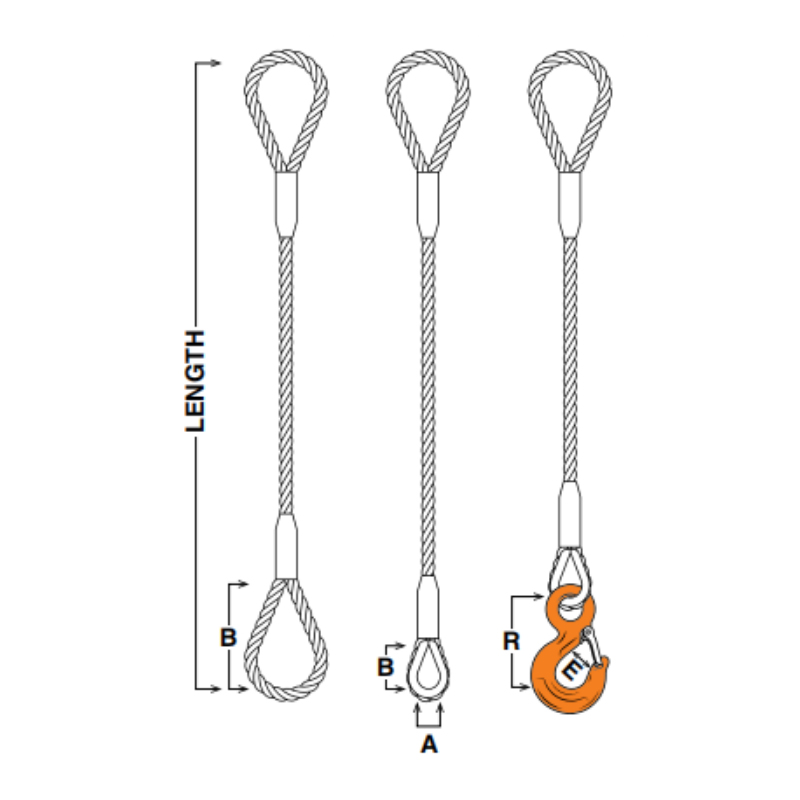 Single-Leg Wire Rope Slings for Straight LiftingEIPS IWRC single-leg slings with eye-eye, eye-thimble or eye-hook terminations, 1/4–2 in diameters, 0.65–37 ton vertical working load limits, and matched thimble/hook ratings.View Product →
If your requirement is mechanical rather than electrical, start from the load and the working environment, then select the rope and termination together. The product card links above lead to the wire rope range and a single-leg sling example for that separate specification path.
A wire is a single conductor; a cable is an assembly that may contain one or many conductors plus insulation, shielding, jacket, and strength members. For electrical procurement, compare conductor count, routing, environment, code path, and installation cost. For lifting procurement, compare rope construction, core, lay, termination, and rated capacity instead.
If you are unsure which category your specification belongs to, send your specification with the application, environment, and expected load or circuit details. That single step prevents most wire-versus-cable mix-ups before they reach the purchase order.
 View More
 View More
 View More
 View More








 English
 Português
