Why Pet Traction Steel Wire Rope Is a Safer Choice Than Synthetic Alternatives
Every dog owner has experienced the moment a leash or tie-out cable fails under unexpected stress—a sudden lunge from a large breed, a frantic sprint toward another animal, or the slow structural fatigue of a nylon cord left outdoors through rain, frost, and UV exposure. Conventional synthetic leashes and plastic-coated rope degrade in ways that are often invisible until the moment of failure: internal fiber breakdown, UV embrittlement, and progressive stretch that removes all meaningful load capacity long before the surface shows visible wear. Pet traction steel wire rope addresses these failure modes at their root. Engineered from the same core technology used in industrial lifting, marine anchoring, and suspension systems, a correctly specified steel wire rope tie-out or leash cable delivers tensile strength measured in hundreds of kilograms, corrosion resistance that survives years of outdoor exposure, and consistent mechanical performance that synthetic materials fundamentally cannot replicate. Choosing the right product, however, requires understanding the key variables that determine how a wire rope behaves in pet traction use.
Understanding Wire Rope Construction for Pet Applications
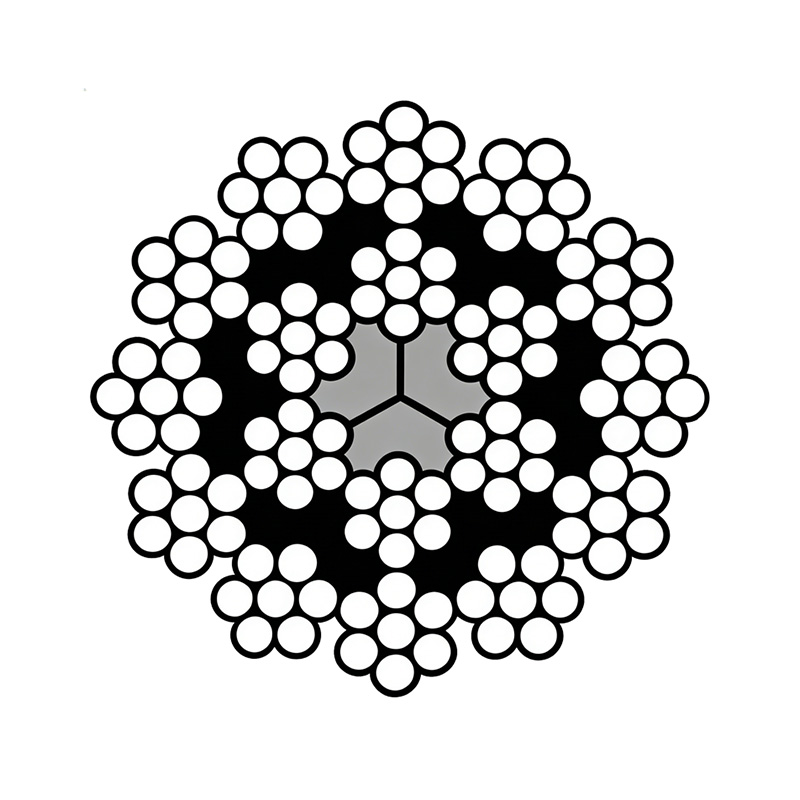
Steel wire rope is manufactured by drawing steel rod into individual wires of precise diameter, twisting groups of those wires into strands, and then helically wrapping multiple strands around a central core. The construction notation—such as 7×7 or 7×19—defines the number of strands and the number of wires per strand. These figures directly govern the rope's balance of stiffness, flexibility, and fatigue resistance, all of which matter enormously in pet traction applications where the cable is repeatedly flexed, pulled at varying angles, and subjected to sudden dynamic shock loads when a dog hits the end of a run line at speed.
- 7×7 Construction: Seven strands of seven wires each. This construction produces a firm, shape-retaining rope with good tensile strength and excellent resistance to kinking. It is well suited for straight tie-out cables and fixed anchor lines where the rope does not need to flex repeatedly through tight bends or redirect around pulleys. The relative stiffness makes it easy to handle and terminate, and its compact cross-section keeps hardware connections clean and secure.
- 7×19 Construction: Seven strands of nineteen wires each. The higher wire count per strand dramatically increases pliability and fatigue resistance, making this the preferred construction for overhead run lines, retractable systems, and any application where the cable passes through pulley hardware or changes direction repeatedly. The 7×19 rope bends smoothly without developing wire fatigue at the flex point, which is critical for systems used multiple times daily over several years.
Core Material Selection
The core running through the center of the rope affects both its mechanical behavior and its environmental durability. A fiber core (FC) adds flexibility and makes ferrule termination more straightforward, but offers slightly less resistance to radial crushing when tension is applied at steep angles—a condition that occurs frequently when a tethered dog circles its anchor point. An independent wire rope core (IWRC) maintains a more stable circular profile under variable tension directions and is the better choice for permanent outdoor installations or tie-out cables used with high-energy dogs that move constantly around the anchor. For lightweight leash cables and short-span tie-outs used with smaller breeds, a fiber core provides entirely adequate performance at a marginally lower cost.
Why Stainless Steel Wire Rope Is the Right Material for Pet Safety
Among all available surface treatments and base materials, stainless steel wire rope stands as the definitive specification for pet traction applications. The reason is straightforward: pet cables are exposed to an unusually aggressive combination of corrosive agents on a daily basis. Saliva from chewing or mouthing the cable, urine contact at ground anchor points, rain, morning dew, pool water, and mud all work continuously to attack metal surfaces. Galvanized carbon steel rope depends entirely on the integrity of its zinc coating to resist this corrosion. When that coating is scratched by a dog's teeth, abraded by pavement contact, or chemically degraded by urine acids, rust begins immediately from the exposed carbon steel beneath—and a rusted wire rope loses both strength and safe contact properties simultaneously. Stainless steel wire rope carries no such vulnerability. Its corrosion resistance is inherent throughout the entire wire cross-section, making it structurally immune to the localized surface damage that causes galvanized alternatives to fail in active pet use.
Selecting the Right Stainless Grade
Not all stainless steel wire rope is metallurgically identical. Two grades are most relevant to pet traction procurement:
- AISI 304 (18% chromium, 8% nickel): The standard austenitic grade providing excellent resistance to atmospheric moisture, detergent residue, and general outdoor chemical exposure. This grade is appropriate for inland residential use, urban parks, and any environment without persistent chloride exposure. Its service life under normal conditions routinely exceeds 15 years, and it represents the most cost-effective stainless specification for the majority of pet owners.
- AISI 316 (with 2–3% molybdenum): The marine-grade alloy engineered specifically to resist chloride-induced pitting corrosion that causes Grade 304 to deteriorate in salt-laden environments. This grade is essential for coastal properties, beach-access dog runs, areas with heavy road salt application in winter, and any permanent outdoor installation where chloride contamination is a recurring condition. The performance premium over Grade 304 in these environments is substantial and fully justifies the modest price difference.
Matching Rope Diameter and Strength to Your Dog's Size and Behavior
Selecting an appropriate diameter is one of the most practically important decisions in specifying pet traction steel wire rope. An undersized rope risks breakage under the dynamic shock load generated when a powerful dog hits the end of a run line at full speed—a force that can temporarily exceed five to eight times the animal's static body weight. An oversized rope is unnecessarily stiff and heavy, creating discomfort for the animal and handling difficulties for the owner. The following sizing guidance covers the full range of domestic breeds:
| Dog Size |
Body Weight |
Recommended Diameter |
Typical MBL |
Best Construction |
| Small breeds |
Under 10 kg |
1.5–2.0 mm |
150–300 kg |
7×7 or 7×19 |
| Medium breeds |
10–30 kg |
2.5–3.5 mm |
400–800 kg |
7×19 |
| Large breeds |
30–50 kg |
4.0–5.0 mm |
900–1,500 kg |
7×19 IWRC |
| XL & working breeds |
50 kg+ |
5.0–6.0 mm |
1,500–2,500 kg |
7×19 or 6×19 IWRC |
These minimum breaking load figures vastly exceed the static body weights they correspond to, which is intentional. The dynamic shock loads generated by a running dog reaching the end of a taut cable require a substantial safety margin above static weight to guarantee that the rope never approaches its failure threshold during normal—or even extreme—use.
Coating Options and Hardware Compatibility
Bare stainless steel wire rope is entirely appropriate for tie-out cables and run lines, but many pet owners prefer a coated variant for direct-contact leash applications. PVC and nylon-coated stainless steel wire rope provides a softer, more comfortable grip surface for the handler, prevents the bare metal wires from abrading the pet's skin or fur at contact points, and adds a layer of mechanical protection against surface scratching. The critical maintenance requirement for coated rope is regular inspection of the sheath—any section showing cracks, splits, or exposed metal must be retired immediately, as moisture infiltrating beneath a damaged coating will corrode the steel core hidden from view. All hardware used with pet traction steel wire rope—swivel snaps, carabiner clips, anchor hooks, and ground stakes—should be rated stainless steel or marine-grade alloy to prevent galvanic corrosion where dissimilar metals contact one another. Swivel fittings at both the collar end and the anchor end are strongly recommended to prevent the rope from developing a permanent twist as the dog moves around the anchor point, which would progressively fatigue the wire strands and reduce service life.
Sourcing Pet Traction Wire Rope From a Trusted Manufacturer
The performance of any pet traction steel wire rope ultimately depends on the manufacturing quality behind the specification. Dimensional tolerances in wire drawing, strand closing tension, and surface treatment consistency all determine whether the finished rope performs as its grade and construction imply—or falls short in ways that only become apparent under real-world load and environmental exposure. Jiangyin General Metals has always been specialised in the field of steel wire rope manufacturing, providing the focused process expertise that translates material specifications into consistently reliable finished products. With a factory covering 20,000 square metres, a workforce of more than 200 people including over 20 engineers and technicians, and advanced equipment operating under a total quality control system, the facility delivers stainless steel wire rope that meets the dimensional, mechanical, and corrosion-resistance standards required for demanding pet traction applications. Strong international supply capability means that importers, distributors, and OEM buyers can source in volume with confidence in both product consistency and delivery reliability—the two factors that matter most when safety-critical applications like pet restraint are involved.



 English
  View More
 View More
 View More

 +86-13395162883 / +86-0510-86361180
 No. 25 Xizhang Road, Changshou Village, Zhouzhuang Town, Jiangyin City, Wuxi City, Jiangsu Province, China