

 English
Chain Slings That Meet ASME Standards: Grade 80/100 B30.9 Selection Guide
Content
- 1 What ASME B30.9 Requires of an Alloy Chain Sling
- 2 The Identification a Tag Must Carry, and What Buyers Should Add
- 3 Angle Multipliers, Not Tag Numbers, Determine Real Capacity
- 4 Hidden Failure Points: Heat, Wear and Hook Geometry
- 5 Where ASME-Compliant Chain Slings Are Consumed
- 6 A Selection Workflow That Survives an Audit
- 7 Maintenance, Records and the Cost of a Missing Certificate
A container of three-leg chain slings arrives tagged "Grade 80, 3/8 in." and nothing else. No serial number, no proof-test record, no heat number, and two latches that will not close. The price was 18 percent below your last approved quote. That is the moment ASME compliance stops being paperwork and becomes a liability decision, because ASME B30.9 is a design, testing, and marking standard: an assembly either has the required chain grade, forged components, proof test, and permanent tag, or it does not.
The conclusion first. For overhead lifting, a chain sling must be built from alloy steel chain made to ASTM A391/A391M (Grade 80) or ASTM A973/A973M (Grade 100), assembled with forged, never welded, master links, coupling links and hooks, proof tested by the manufacturer, and marked with a permanently attached tag. Grade 30 proof coil, Grade 43 high-test and Grade 70 transport chain are load-securement products; ASME B30.9 and OSHA 1910.184 do not permit them in overhead lifting slings, whatever a supplier's catalog implies.
What you can verify before the truck is unloaded
- Grade stamped into the chain links themselves, 80 or 100, not only printed on a tag.
- A design factor of at least 4:1, with every component rated at least as high as the finished assembly.
- A metal tag fixed at the master link carrying the identification data listed below.
- A proof-test record at roughly twice the rated load, traceable by serial number and heat number.
What ASME B30.9 Requires of an Alloy Chain Sling
ASME B30.9, Slings, devotes Chapter 9-2 to alloy steel chain slings; ASME B30.10 covers hooks; OSHA 29 CFR 1910.184(c) repeats much of the same language for general industry. The standard rests on four engineering demands rather than on appearance.
Chain material
Chain must be alloy steel produced to ASTM A391/A391M for Grade 80 or ASTM A973/A973M for Grade 100. A mill test certificate carrying the heat number is the only practical proof of metallurgy; a tag cannot confirm it.
Forged components
Master links, coupling links and hooks must be forged and rated at least equal to the assembly's rated load. Welded chain, welded master links and field-welded repairs are removal items, not cost options.
Design factor
Rated loads are based on a minimum 4:1 design factor against ultimate strength. That is why a 3/8 in. Grade 80 sling cannot be swapped for the same size in Grade 43 or Grade 70.
Proof test and tag
The maker proof tests the finished assembly, typically at twice its rated load, then fixes a permanent tag. Assemblies sold without that test cannot be documented as compliant.
A ready-made two-leg assembly with forged open hooks shows how this works in practice: chain, hooks and master link drawn from one heat-controlled production run, then tested and tagged as a unit instead of assembled from mixed stock.
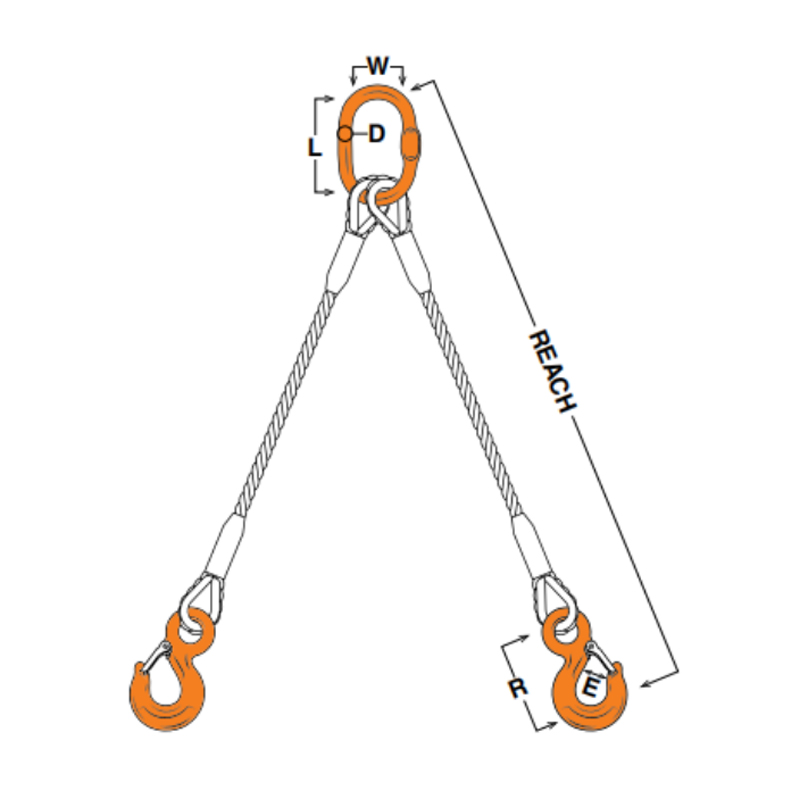
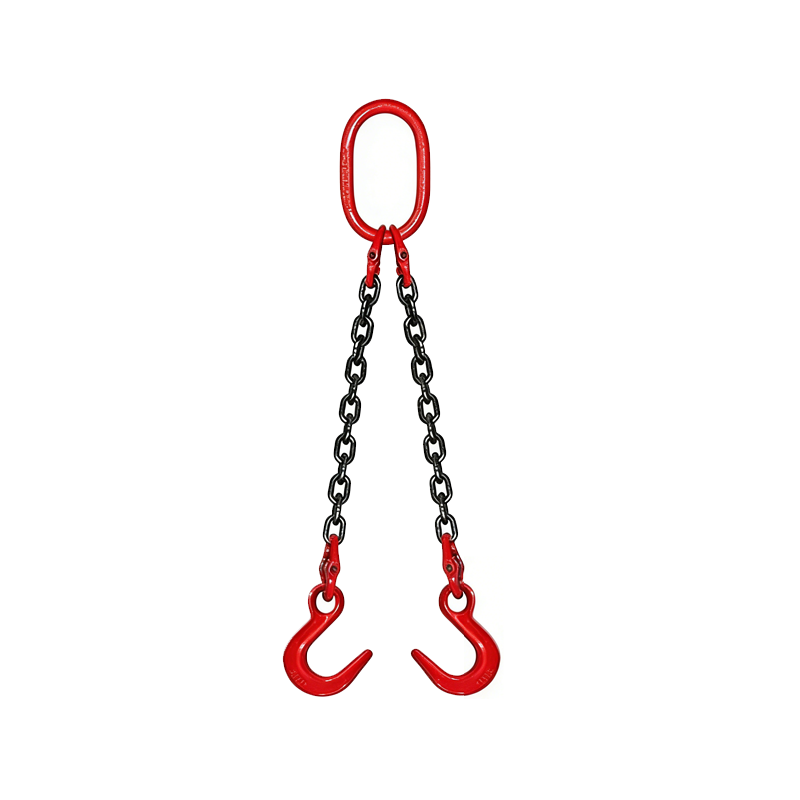 Grade 80 Two-Leg Chain Sling with Forged Open HooksTwo-leg Grade 80 alloy steel sling with forged open hooks and master link, proof-tested and tagged as a complete assembly for overhead lifting.View Product →
The Identification a Tag Must Carry, and What Buyers Should Add
ASME B30.9 requires each sling to be marked with the manufacturer's name or mark, the chain grade, the nominal chain size, the rated load for the type of hitch used, the reach, the number of legs, and a unique serial number. Most current tags also carry the date of manufacture. The tag must be durable and attached at the master link; a paper or hand-written replacement, or one painted over, puts the sling out of service until a qualified person re-identifies it.
- Manufacturer's name or identifying mark.
- Chain grade: 80, 100 or 120.
- Nominal chain size in inches or millimeters.
- Rated load for each type of hitch.
- Reach, meaning the working length from master link to hook.
- Number of legs.
- Serial number, with the date of manufacture on current tags.
For imported assemblies, add two items that B30.9 does not spell out but a defensible quality system should: a mill test certificate to EN 10204 3.1 tying chain and fittings to heat numbers, and a proof-test record for the finished assembly matched to its serial number. Without them, a sling can carry a fully compliant tag and still be impossible to defend after an incident.
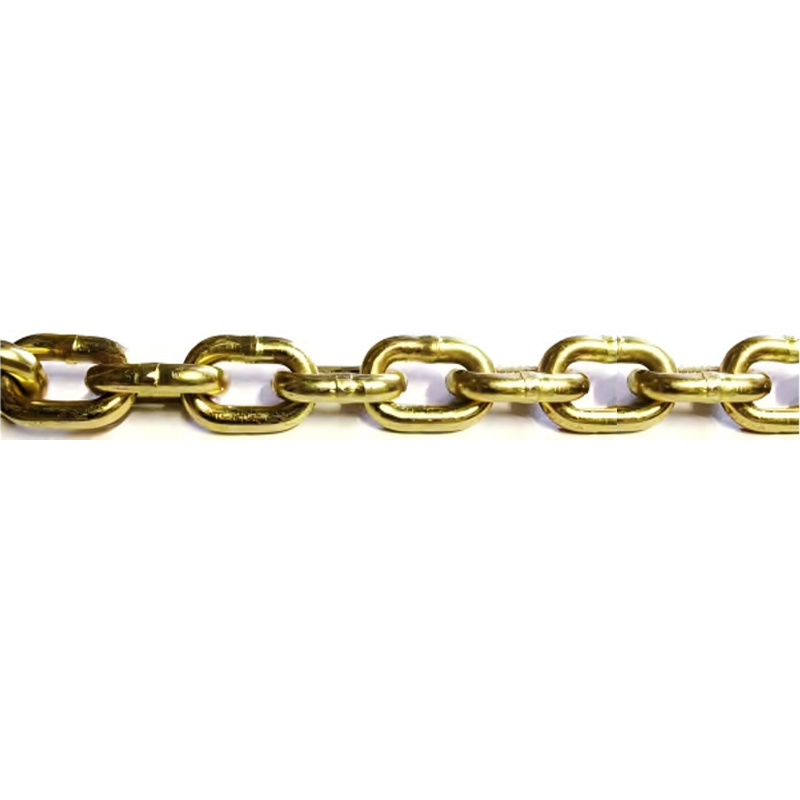
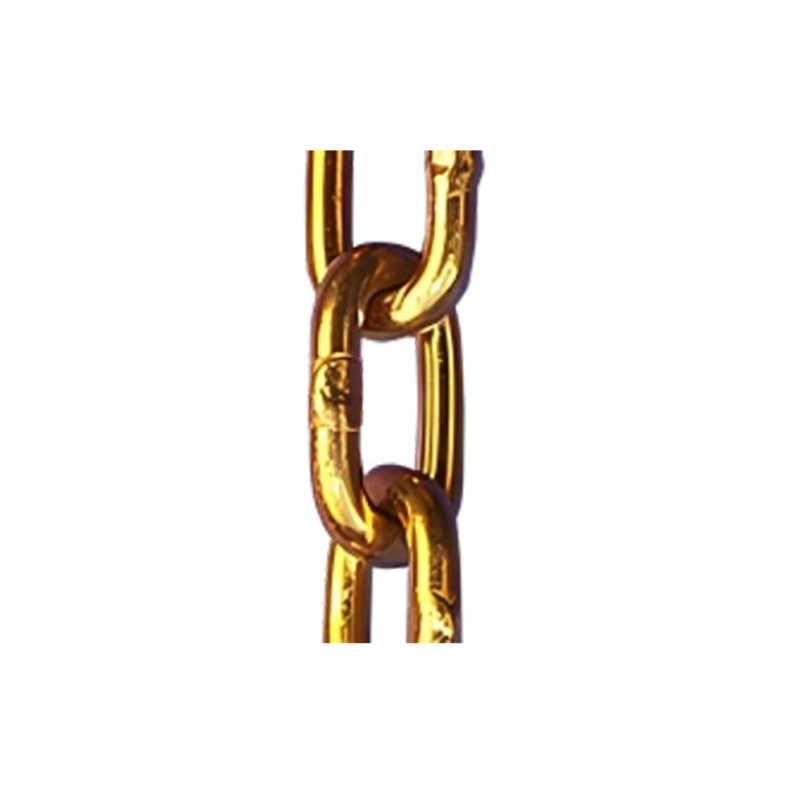
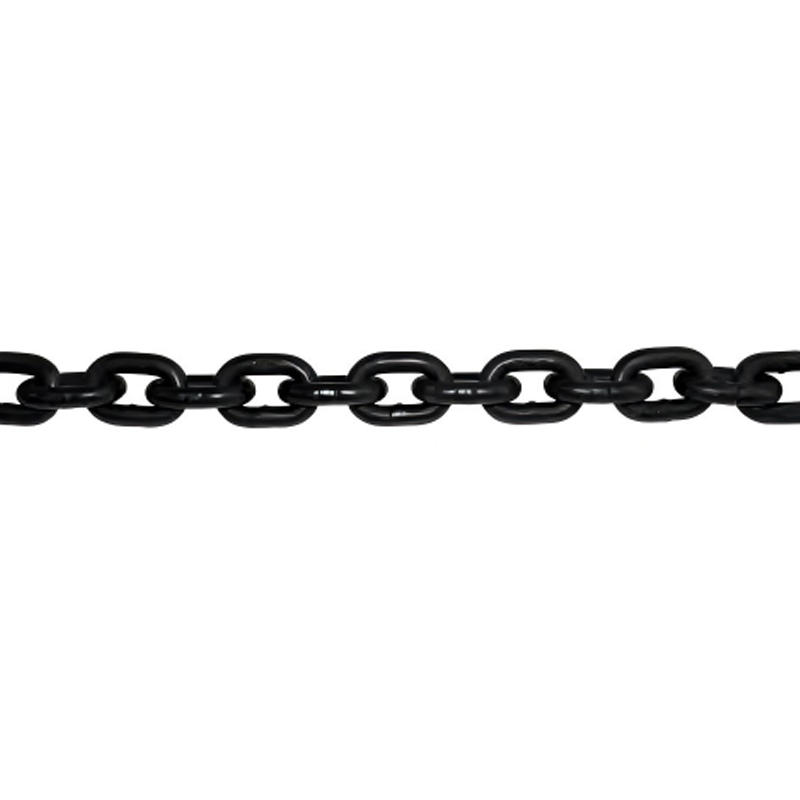 Grade 80 Heat-Treated Alloy Steel Lifting ChainHeat-treated Grade 80 alloy chain, proof load tested and available in multiple sizes for certified overhead lifting and sling assemblies.View Product →
Angle Multipliers, Not Tag Numbers, Determine Real Capacity
The rated load on a two-leg tag assumes the legs sit at one specific angle. ASME B30.9 rates multi-leg slings by the angle measured from the horizontal, and the fall-off is steep: a two-leg sling at 30 degrees from horizontal, a wide and flat hitch, delivers no more capacity than a single vertical leg, however much chain is in the assembly.
Illustrative load factors: multiply the single-leg rated load by the factor for the number of legs and the angle above horizontal. Confirm against the current ASME B30.9 table and the tag on the specific sling.
Two consequences matter in purchasing. First, three-leg and four-leg factors assume symmetric loading; on a rigid load two legs may carry everything, so a four-leg factor of 3.46 is not a guarantee. Second, grade selection buys capacity where geometry is the constraint: Grade 100 chain carries roughly 25 percent more than Grade 80 in the same link size, which often allows a smaller, lighter sling inside a tight hitch.
Hidden Failure Points: Heat, Wear and Hook Geometry
Most inspection rejections are not dramatic failures. They are a link stretched about 5 percent from its original dimensions, a hook throat opened beyond 15 percent of the original, or a sling worked at full rated load in hot service.
1.00
Up to 400 F (204 C)
0.90
400 to 475 F (204 to 246 C)
0.75
475 to 600 F (246 to 315 C)
0.65
600 to 700 F (315 to 370 C)
Typical elevated-temperature load factors published for Grade 80 alloy chain. ASME B30.9 requires a reduction above 400 F (204 C), and most chain makers prohibit lifting service above roughly 700 F (370 C). Verify exact factors with the chain manufacturer.
Cold is the other hidden variable. Below about -4 F (-20 C), alloy chain loses impact resistance, and a sling that is compliant at room temperature can crack under a shock load on a winter site. Wear limits follow the same logic: a uniform reduction in link diameter beyond the chain maker's limit, commonly near 10 percent of nominal, retires the chain even though it still looks intact. Heating, welding, straightening or re-painting a chain sling is never a repair; each is a removal criterion.
Where ASME-Compliant Chain Slings Are Consumed
Compliant assemblies are a maintenance and production item rather than a specialty purchase. The split below is an illustrative planning model drawn from typical industrial and OEM order mixes, not a market survey, but it is useful for judging which hitches and capacities a distributor should stock.
- 34% Manufacturing, machining and general industrial maintenance
- 26% Construction, steel erection and infrastructure work
- 16% Energy, utilities and power plant maintenance
- 12% Ports, marine, rail and heavy transport
- 12% Agriculture and other lifting duties
The practical reading: two-leg and four-leg assemblies in 5/16 in. through 1/2 in. Grade 80 or Grade 100 sizes carry most of the volume, while single-leg slings with safety hooks dominate maintenance and utility work where a latch is mandatory.
A Selection Workflow That Survives an Audit
Step 1: Start from the load
Add rigging weight and any shock or wind allowance, then define the hitch before opening a catalog.
Step 2: Convert to a required leg capacity
Apply the angle and leg-count factors above, then check the most heavily loaded leg, not the average.
Step 3: Specify the standard in writing
State on the purchase order: slings to ASME B30.9, chain to ASTM A391/A391M Grade 80 or ASTM A973/A973M Grade 100. When capacity is tight, published Grade 100 alloy steel chain strength specifications help confirm whether a smaller link size is genuinely sufficient.
Step 4: Require documentation
Mill certificate to 3.1, proof-test record, serial-numbered tag data and the maker's stated removal criteria.
Step 5: Verify on receipt
Check link markings, tag data, latch function, hook throat opening and certificate-to-serial match before the sling enters service.
Step 6: Set inspection intervals
Frequent visual inspection before each shift in daily service, periodic inspection by a designated person at least annually, quarterly in severe conditions.
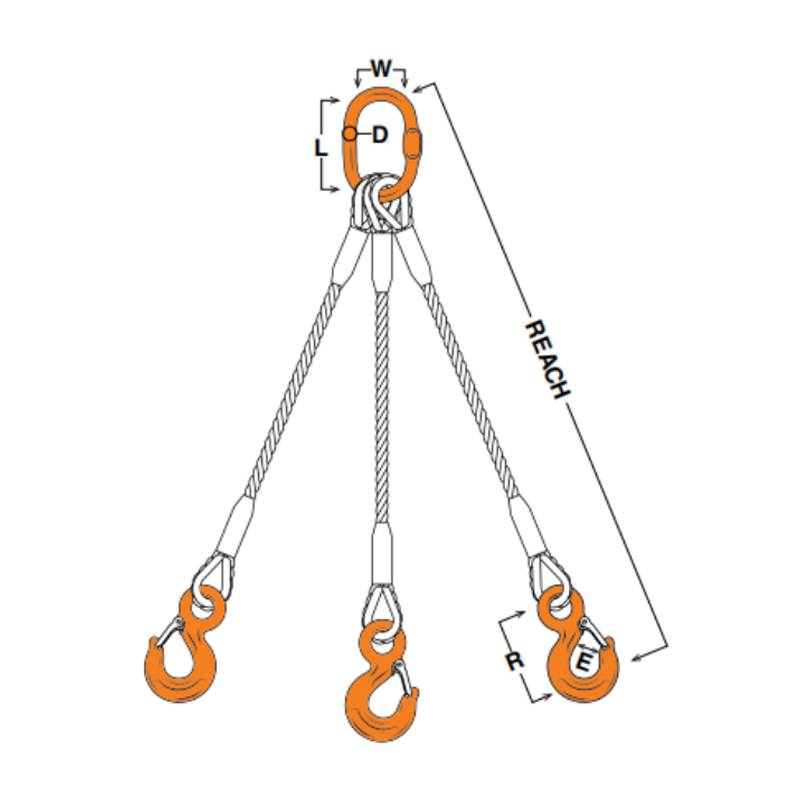
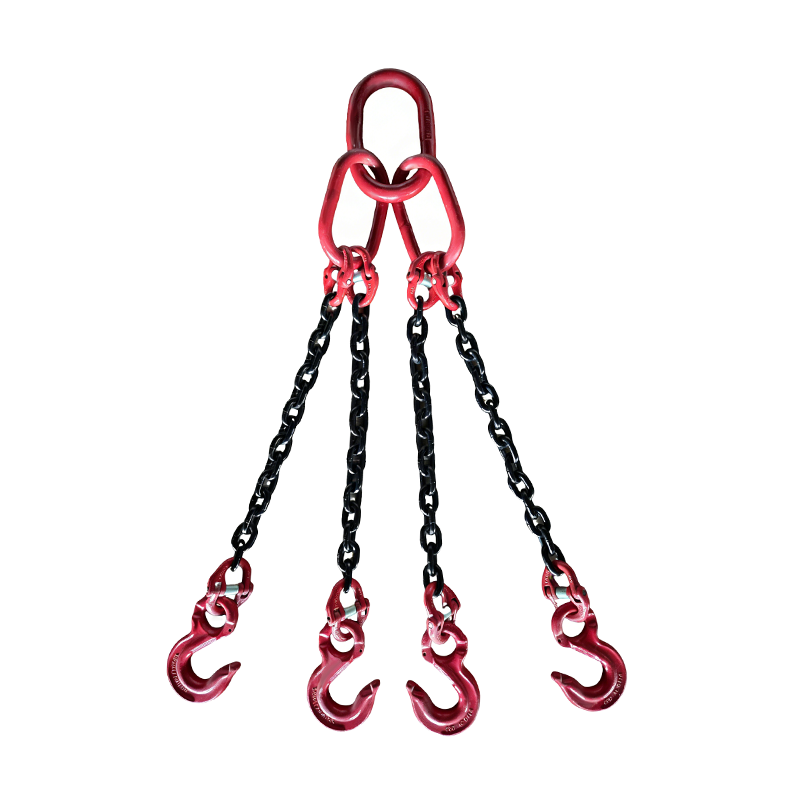 Grade 100 Four-Leg Chain Sling with Swivel Safety HooksFour-leg Grade 100 alloy chain sling with independently swiveling safety hooks, proof-tested, tagged, and certified for demanding overhead lifting.View Product →
Maintenance, Records and the Cost of a Missing Certificate
A chain sling is not repaired, it is retired. Any of the following removes it from service permanently:
- Cracked, nicked or gouged links, or nicks deeper than about 0.060 in. (1.5 mm).
- Elongation or stretch beyond the chain maker's limit, typically about 5 percent.
- Uniform wear reducing link diameter beyond the published limit, commonly around 10 percent.
- Twisted, bent or heat-damaged links, including arc strikes and weld spatter.
- Missing, broken or non-functioning hook latches.
- Hook throat opening increased more than 15 percent of the original dimension under OSHA 1910.184, or the stricter limit published by the hook maker.
- Heavy corrosion, pitting or any weld repair.
Keep two records per sling: the periodic inspection sheet signed by the designated person, and the original proof-test and certificate package filed against the serial number. When a tag is lost or illegible, the sling cannot simply be re-tagged from memory; a qualified person must re-identify it or the assembly comes out of service. Storage matters less than paperwork but still counts: hang slings off the floor, away from acid, weld spatter and open flame, and never use a chain sling as a tow line or a choker around a sharp edge without protection.
A compliant chain sling is defined by evidence, not by appearance: alloy chain to ASTM A391 or A973, forged fittings, a 4:1 design factor, a proof test at twice rated load, and a permanent tag tying all of it to a serial and a heat number. Buyers who enforce those five points on the purchase order rarely discover the problem at the moment of a lift. If you need assemblies configured to your hitch, capacity and tag format, send us the load and geometry details and we will quote the chain grade, reach and component set that fit.
Contact Us
-

-
 +86-13395162883 / +86-0510-86361180
 -
 No. 25 Xizhang Road, Changshou Village, Zhouzhuang Town, Jiangyin City, Wuxi City, Jiangsu Province, China


- Quick Links
- Product Categories
- Wire Rope
- Wire Rope Fittings
- Chain
- Wire Rope Accessories
- Packaging Types

Message Us Now !
