

 English
 Português
Chain Slings That Meet NACM Standards: A Grade 80 and 100 Buyer's Guide
Content
A rigging buyer opens a container of 3/8-inch grade 80 chain slings, every link stamped “80,” and asks one question: will these survive an audit? The stamp on its own proves very little. NACM compliance is a chain of evidence — heat-treated alloy steel of the right grade, a proof test at twice the working load limit, a legible grade mark on every link, fittings rated to match, and an identification tag whose serial number ties back to a test certificate. Break any one link in that chain and the sling stops being compliant, even when the steel itself is perfectly sound.
Bottom line: buy the certificate, not the stamp. A NACM-compliant chain sling is one whose grade marking, proof load record, fitting ratings and ID tag all agree — and can be produced within a day of an auditor asking for them.
What NACM Compliance Actually Requires
The National Association of Chain Manufacturers publishes welded steel chain specifications that North American rigging buyers treat as the baseline for lifting chain. Grades 30, 43 and 70 appear in those tables too, but they are transport and tie-down products. Only grade 80 and grade 100 alloy chain — and the occasional grade 120 — belong in an overhead sling, and the specification controls far more than tensile strength:
- Alloy steel chemistry with a quench-and-temper heat treatment, and no field welding or reworking of links.
- A proof test at twice the working load limit before the sling leaves the factory, as required by OSHA 1910.184 and ASME B30.9.
- A minimum breaking force consistent with a 4:1 design factor over the rated capacity.
- Measurable ductility, so an overloaded link stretches visibly before it fractures instead of snapping.
- Grade and manufacturer identification marked on the chain, plus a sling tag showing capacity, reach, configuration and serial number.
Marking on every link
A grade mark that appears only on the tag, or only on the master link, is not a NACM marking. Inspectors look at the chain body.
Proof load at 2x WLL
Proof testing removes defective assemblies and proves the whole sling, not just a sample of chain from the coil.
Matched fittings
Hooks, master links and couplers must be rated at least equal to the chain grade; a grade 80 hook on grade 100 chain caps the assembly.
One nuance matters during sourcing: NACM is a manufacturer specification, not a third-party certification scheme. There is no independent mark stamped by an outside body, so the test certificate and the traceable tag carry the same weight as the grade stamp. Suppliers who cannot produce both are asking you to take the risk on their word.
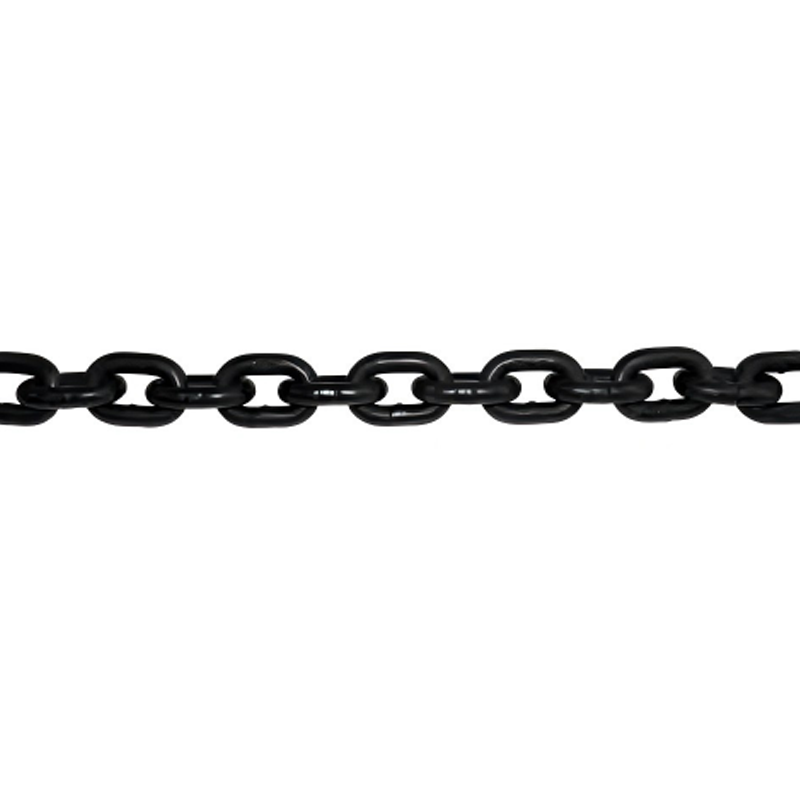 Grade 80 Heat-Treated Alloy Overhead Lifting ChainProof load tested to rated WLL and available in eight sizes, this Grade 80 chain suits hoists, cranes and multi-leg sling assemblies.View Product →
Grade 80 vs Grade 100: Matching Capacity to the Lift
Both grades are acceptable for overhead lifting, so the decision is usually economic rather than legal. Grade 100 chain is drawn from a stronger alloy and delivers roughly a quarter more capacity in the same diameter and the same weight per metre — which lets a rigger drop a size or shed a leg on a heavy lift.
Rated working load limits for a single-leg vertical lift in pounds, taken from standard NACM grade tables; capacity gain is the grade 100 advantage at the same nominal diameter.
Do not read that table as “grade 100 is always better.” Grade 80 remains the workhorse for mixed fleets because it is interchangeable with the hooks and couplers most workshops already stock, and it is more forgiving of abuse in dirty, abrasive environments where chain wear is the real limiting factor. Grade 100 pays off on high-cycle crane work and on lifts where a lighter sling reduces operator fatigue or allows a smaller crane hook. Whichever you choose, the whole assembly — chain, hooks, master link, tag — must sit at that grade or above.
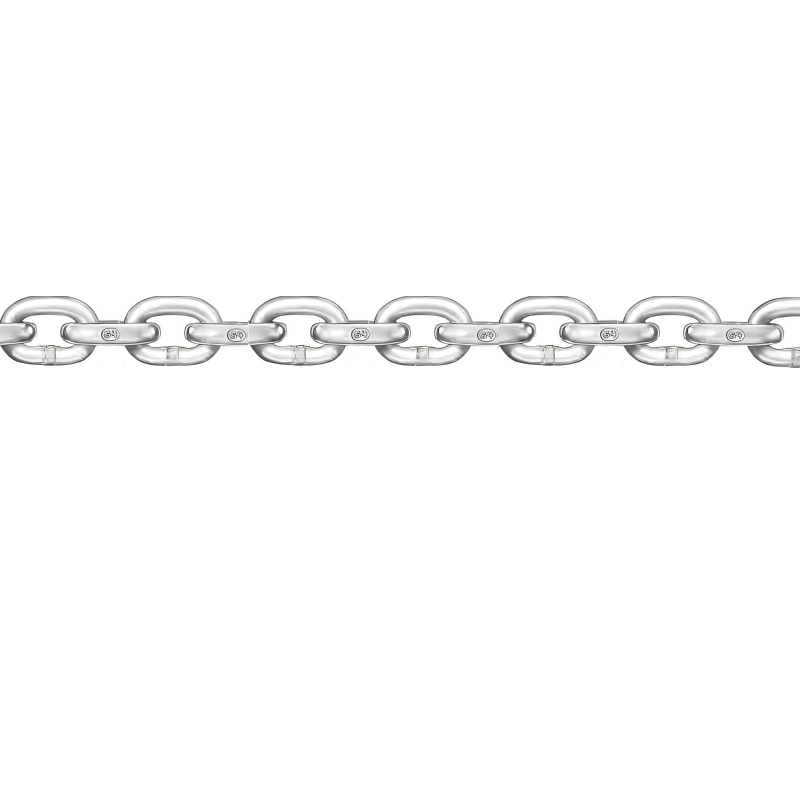
 Grade 100 Heat-Treated Alloy Lifting ChainWith 25% higher WLL than Grade 80 equivalents and proof testing at twice the working load, it suits high-cycle crane and rigging work.View Product →
The Hidden Variables That Cut Rated Capacity
Most capacity failures on site have nothing to do with the chain grade. They come from configuration. A two-leg sling rated at 8,800 lb per leg does not lift 17,600 lb unless the legs hang vertically; widen the included angle and the geometry quietly removes load from the tag.
100%
Single vertical leg
173%
Two legs, 60° included
141%
Two legs, 90° included
100%
Two legs, 120° included
80%
Choker hitch
200%
Basket hitch
Effective capacity of a grade 80 sling assembly expressed as a percentage of one vertical leg; angle factors follow standard rigging practice and apply equally to grade 100.
Three further deductions are easy to miss when specifying. First, wear: a link that has lost 10% of its nominal diameter no longer carries its tag capacity and should be removed from service, which is why abrasive yards inspect more often than the annual minimum. Second, heat and corrosion: a sling that has been through a fire, a hot dip or a galvanic bath cannot be re-rated, and stainless grades 50 and 63 used in food or marine work are deliberately weaker than grade 80. Third, fittings: a hook that has opened up, lost its latch, or is a lower grade than the chain becomes the weakest element in a supposedly compliant assembly.
- Reject any sling whose tag serial cannot be matched to a proof test record.
- Reject chain with grades marked only on the tag or only on the end fitting.
- Reject assemblies mixing grades without a documented, re-rated WLL.
Where NACM-Compliant Slings Are Used
Demand clusters around a handful of industries, and each one stresses the sling differently. That pattern is worth knowing when you set a specification, because the inspection interval should follow the application rather than a single company-wide rule.
- Structural steel fabrication — 32%
- Construction and pre-cast yards — 24%
- Oil, gas and petrochemical — 18%
- Mining and quarrying — 14%
- Transport, marine and heavy haul — 12%
Indicative split of overhead lifting chain sling consumption by end-use sector; proportions shift with regional industrial cycles.
Fabrication shops want short reach, four-leg assemblies with self-locking hooks so a plate can be flipped without dropping a leg. Construction prefers two-leg slings with grab hooks for rebar bundles and pre-cast panels. Petrochemical and mining sites usually demand grade 100 plus quarterly inspection, because a dropped load in those environments is measured in downtime, not just damage. A single supplier who can deliver the same tag and certificate format across all four sectors saves buyers a surprising amount of administration.
A Sourcing and Verification Workflow
The practical sequence below is what keeps a purchase order from turning into a non-conformance report six weeks later. It also happens to be the fastest way to compare two quotations that look identical on paper.
Step 1 — Fix the load case
Record mass, centre of gravity, leg count, included angle, hitch type and environment. These inputs decide capacity long before grade does.
Step 2 — Size on working load limit
Start from the NACM vertical WLL, apply the angle and hitch factors, and keep a margin for wear and off-centre loading.
Step 3 — Request documentation with the quote
Ask for the proof test certificate at 2x WLL, material and grade declaration, fitting certificates, and a sample tag layout.
Step 4 — Verify on arrival
Check grade marks on the chain body, tag serial against the certificate, hook latch function and master link grade.
Step 5 — Register and tag internally
Assign an asset ID, log WLL, reach, configuration and date in service, then schedule the first periodic inspection.
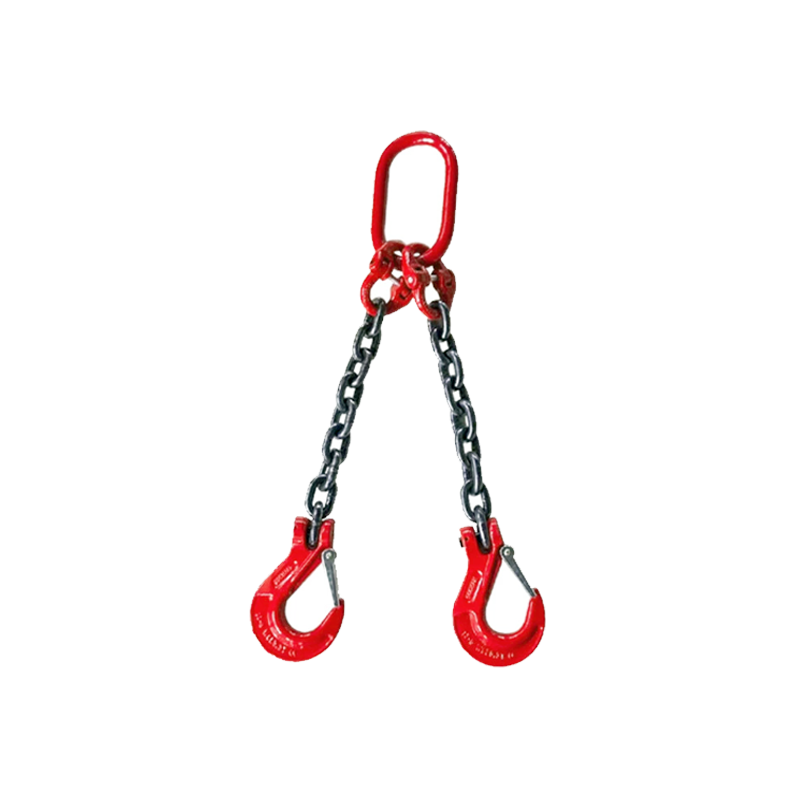 Two-Leg Chain Sling with Swivel Hooks and EqualizerSwivel equalizer adjusts both legs for uneven loads, while independently rotating safety-latched hooks reduce twist; supplied with ID tag and traceability documents.View Product →
Inspection, Marking and Recordkeeping
A compliant sling stays compliant only while its paperwork and its condition stay in step. OSHA 1910.184 and ASME B30.9 expect a documented periodic inspection — annually at minimum, and more frequently where chains meet abrasion, chemicals or heat. The record should name the sling by serial number, state the inspection date and result, and be signed by a competent person.
- Remove from service at roughly 10% loss of nominal link diameter, or on any crack, gouge, nick or weld spatter.
- Remove any sling showing elongation, twist, or links that no longer sit flat in the same plane.
- Remove hooks with an opened throat, a missing latch or a deformed bowl, and any bent or twisted master link.
- Remove slings with heat discolouration or missing, painted-over or illegible tags — the tag is part of the equipment.
Never repair a lifting chain by welding, and never re-stamp a sling to a higher capacity after replacing a component. Retire it, and keep the retirement record: auditors increasingly ask not just what is in service, but what was removed and why. Storage matters too — hang slings clear of the floor in a dry rack so that abrasion and corrosion do not start the clock on the next inspection early.
Specifying chain slings that meet NACM standards comes down to four documents and four checks: grade marking on the chain body, a proof test at twice the working load limit, fittings rated at or above the chain grade, and a serialised tag that matches the certificate. Get those right and the grade 80 versus grade 100 argument becomes a straightforward cost-per-lift calculation instead of a safety gamble. Buyers comparing suppliers can review our grade 80 and grade 100 sling guide for the underlying capacity tables, or send us the load case and we will confirm the assembly, certificate pack and marking scheme before the order is placed.
Related Products
-
 View More
-
 View More
Towing & Load Securement Grade 43 High-Test Carbon Steel Chain
-
 View More
ASTM A1023 35x7 Rotation Resistant Category 1 Steel Wire Rope
-
 View More
ASTM A1023 34x7 Rotation Resistant Category 2 Steel Wire Rope
-
 View More
ASTM A1023 19x7 Rotation Resistant Category 2 Steel Wire Rope
-
 View More
ASTM A1023 8x19 Rotation Resistant Category 3 Steel Wire Rope
Contact Us
-

-
 +86-13395162883 / +86-0510-86361180
-
 No. 25 Xizhang Road, Changshou Village, Zhouzhuang Town, Jiangyin City, Wuxi City, Jiangsu Province, China


- Quick Links
- Product Categories
- Wire Rope
- Wire Rope Fittings
- Chain
- Wire Rope Accessories
- Packaging Types

Message Us Now !
