Content
A 13 mm Grade 80 chain sling arrives from the supplier tagged at 5.3 t. Rig that same chain as a two-leg assembly at 35 degrees from vertical and the assembly is rated at roughly 7.4 t, not 10.6 t. Re-reeve it as a choker and the figure drops again. The steel has not changed at all, only the geometry and the hitch, and both of those are part of the rating.
That gap between the number stamped on the tag and the real capacity of the lift in front of you is where most overload incidents begin. It is also where a chain working load limit stops being a single figure and becomes a short calculation that a competent rigger should be able to run in their head.
A chain working load limit is the rated capacity of a specific assembly in a specific configuration. Grade, link diameter, hitch type, number of legs and angle from vertical all feed into it, and the assembly is only as strong as its weakest rated component. Treat the tag as the starting point, never as the final number.
The working load limit is not the point at which the chain breaks. It is the point at which the chain is still carrying the design factor the relevant standard demands. For alloy steel chain slings under EN 818-4 or ASME B30.9, that design factor is 4:1. A sling rated at 5.3 t therefore has a minimum breaking force of about 21.2 t and is normally proof tested to twice its WLL before it ever leaves the bench.
Three numbers travel with every chain: working load limit, proof load and minimum breaking force. Only the first belongs on a lift plan. The other two exist to tell an inspector how much margin is left after wear, and to prove the assembly was sound on the day it was made.
Minimum breaking force is four times the marked WLL for Grade 80 and Grade 100 sling chain.
Assemblies are proof loaded to twice the WLL, which catches defective links before service.
Grade, size, WLL, manufacturer identity and a certificate number should all be readable on the tag.
The second thing the figure certifies is the whole assembly rather than the chain alone. A 5.3 t chain fitted with a 3.15 t hook is a 3.15 t sling. Master links, connectors, hooks and shackles each carry their own rating, and the assembly WLL is the lowest of them.
Grade 80 (T8) and Grade 100 (T10) alloy chain dominate overhead lifting. Grade 100 returns roughly a quarter more capacity in the same link diameter, which is why higher-duty fleets have moved to it. The trade-off is that Grade 100 stretches less before failure, so it gives less visual warning; inspection discipline has to be tighter, not looser.
Two notes for buyers. Grade 80 remains the most widely accepted grade in general fabrication and rental fleets, so it is still the safer choice when the sling will be used by people outside your own team. And mixing grades inside one assembly is not permitted: a Grade 100 leg on a Grade 80 master link makes the assembly Grade 80 at best, and often nothing at all if the markings cannot be reconciled.
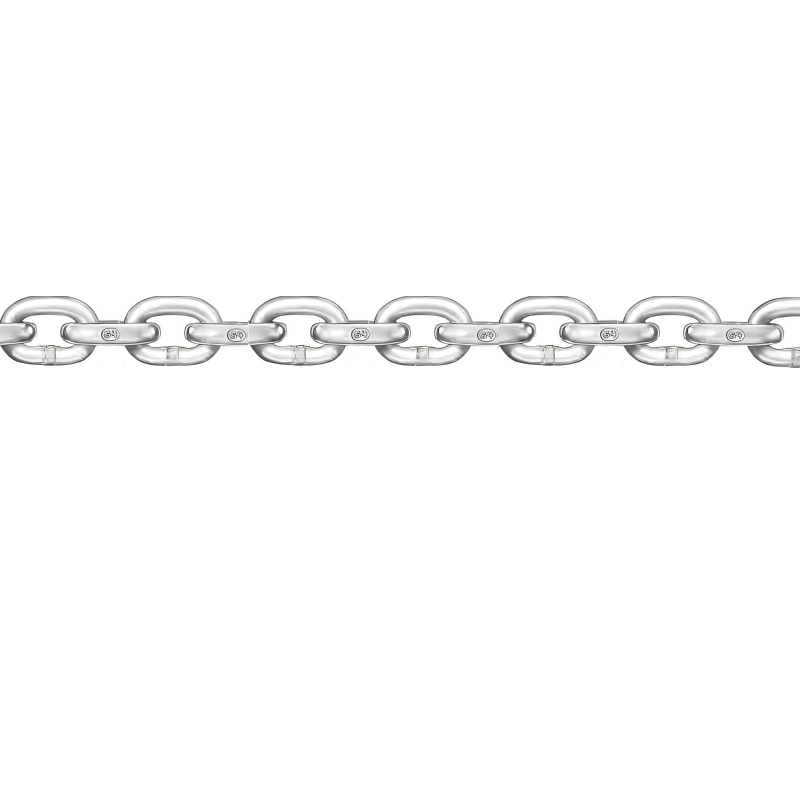
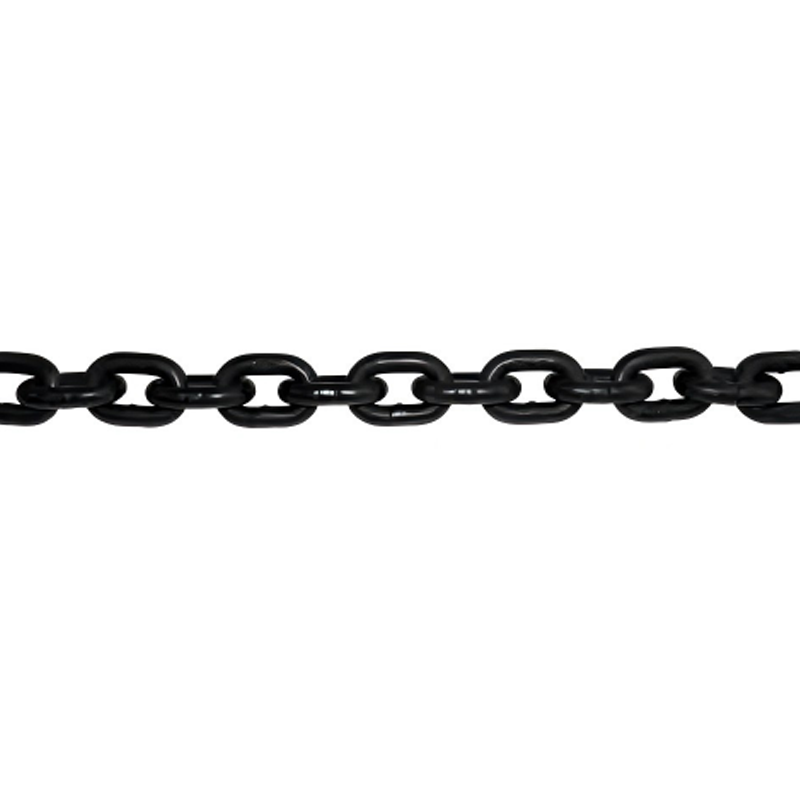 Grade 80 Alloy Steel Lifting ChainHeat-treated, proof-tested Grade 80 chain in sizes from 7 to 26 mm, rated 3,500 to 47,700 lb; a widely accepted choice for overhead lifting assemblies.View Product →
Mode factors for multi-leg slings are set by standard rather than by judgement. A single leg is 1.0. Two legs at 0 to 45 degrees from vertical take a factor of 1.4; at 45 to 60 degrees the factor falls to 1.0. Three- and four-leg assemblies use 2.1 and 1.5 across the same two angle bands. Hitch factors work the same way: vertical 1.0, choker 0.8, basket 2.0, subject to how the hooks are seated.
Two things get lost in the tables. First, mode factors are capped by an angle band, not by an exact angle, so a two-leg sling at 44 degrees and one at 46 degrees sit in different rows with a 40% difference in rating. Second, the factors assume the load is shared evenly. An off-centre centre of gravity can put most of the load into one leg, and no standard table protects against that. Balance the load or accept a lower rating.
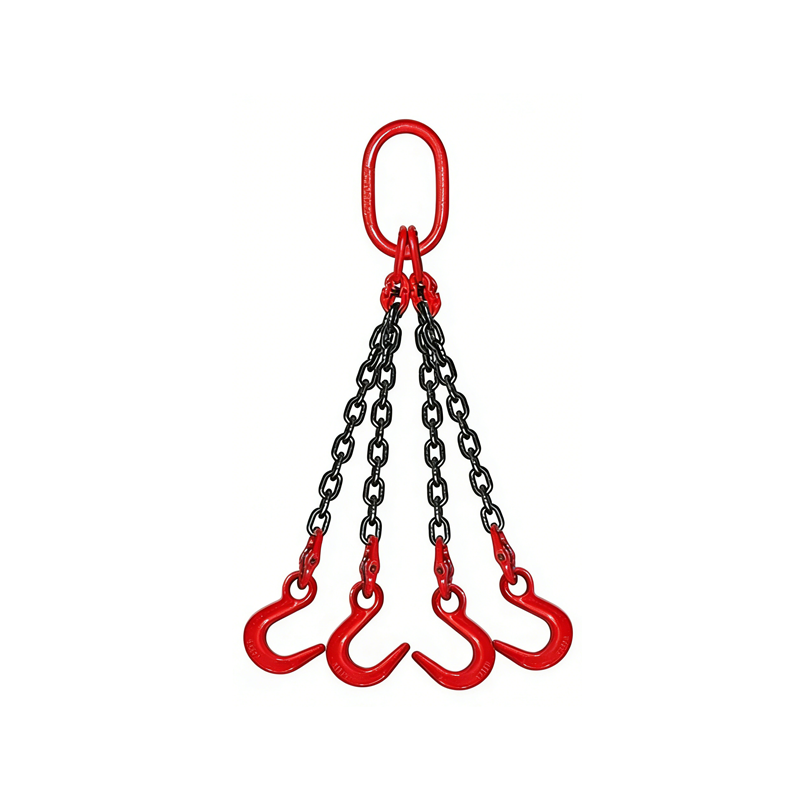 Four-Leg Chain Sling with Forged Open HooksFour-leg alloy chain sling with forged open hooks, 7–22 mm legs, rated 4.48–65.2 t vertical; review rating for angle and load balance.View Product →
Capacity losses in service rarely come from a single overload. They come from wear, corrosion and heat, which reduce the section carrying the load while the tag still says 5.3 t. The split below reflects the general pattern of chain sling demand we see across lifting work; treat it as a planning illustration rather than a market survey.
Abrasive duty eats into capacity faster than load weight does. The 10% link diameter rule exists because that is roughly the point where the remaining section can no longer be trusted at the marked figure. In foundries, heat is the bigger enemy: alloy chain should not be used above the temperature ceiling given by the manufacturer, and above roughly 200 degrees Celsius for Grade 80 you need written guidance before the sling goes back into service.
Step four is the one that most often gets skipped during rushed procurement. Master links and connectors are cheap relative to the consequences, yet they are also the parts most likely to be sourced separately and assembled without a rating check. Grade 100 master links are available with matching sub-assemblies so the top of the sling does not become the weak point.
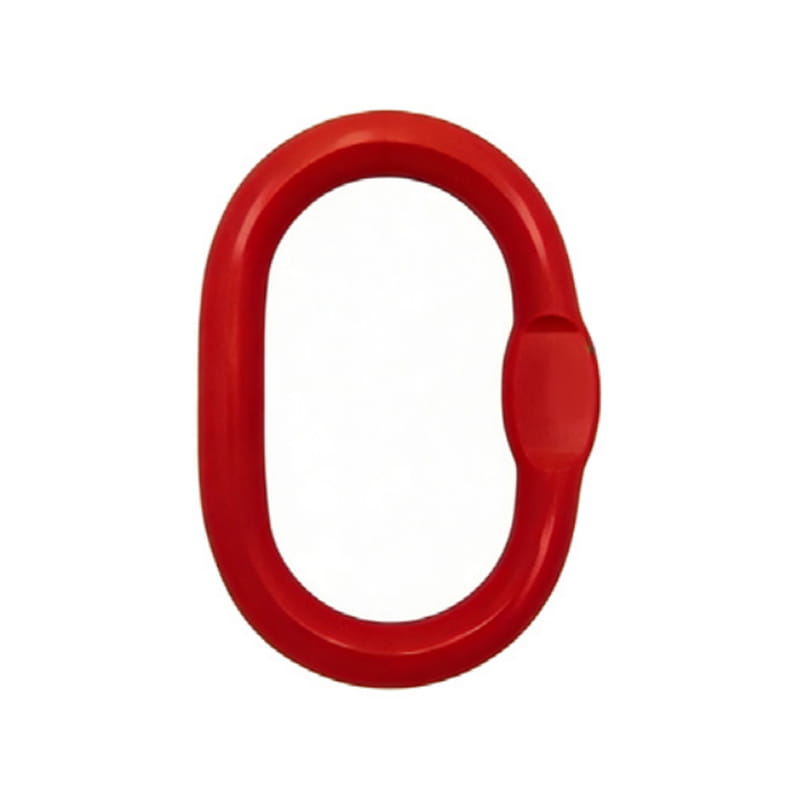 Grade 100 Master Links for Multi-Leg SlingsForged, heat-treated Grade 100 master links for two-, three-, and four-leg slings, sized 1/2 to 2 in with chain WLLs up to 103,600 lb.View Product →
A chain sling should be inspected before every use and given a documented periodic inspection by a competent person, typically at intervals not exceeding twelve months, with the frequency tightened for abrasive or corrosive duty. Withdraw the assembly when any of the following appear:
Records matter as much as the physical check. Keep the certificate, the proof test report and the inspection history against the sling's unique ID, because in any incident review the first question will be what the assembly was rated for and when it was last examined. OSHA 1910.184, ASME B30.9 and EN 818-6 all follow the same logic even where the wording differs.
For a closer look at wear limits, tag requirements and rejection criteria, our practical guide to chain sling inspection walks through the same checklist an inspector would use on site.
Many lifts combine chain slings with wire rope slings, and the two do not carry the same design factor. Wire rope slings are generally rated at 5:1, chain slings at 4:1, so a mixed assembly takes the lower rating and the more conservative inspection regime. Buying both from one production base removes one common source of error, since the ratings, certificates and test reports arrive in a consistent format and the fittings are matched before they ship. You can see how that works on our factory and production page.
The practical takeaway is simple: read the tag, apply the hitch and angle factors, check every component, and keep the paperwork with the sling. A working load limit is only as reliable as the person who applies it.
 View More
 View More
 View More
 View More
 View More
 View More








 English
 Português
